Understanding EHCP applications, timelines, school placement, reviews and appeals.
An Education, Health and Care Plan (EHCP) is one of the most important support documents a child with additional needs can have in England.
It is a legal document that describes a child’s special educational needs and the support they must receive in education.
But the process around EHCPs can feel confusing.
Parents often hear different things from schools, local authorities, other parents, and online forums.
One person says you must wait for the school. Another says you must gather reports first. Someone else says the process takes years.
When you first start reading about EHCPs, it can feel like stepping into a maze.
What This Guide Covers
This EHCP Explained for Parents Guide breaks down the EHCP process in England from beginning to end.
Inside this guide, you will learn:
- What an Education, Health and Care Plan (EHCP) is and who it is for
- The difference between SEN Support and an EHCP
- Who can request an EHC needs assessment
- How to apply for an EHCP
- What evidence strengthens an EHCP application
- How the 20-week EHCP timeline works
- What happens during the EHC needs assessment
- What parents should check in a draft EHCP
- How EHCP sections (B, F and I) work
- How school placement are decided
- What happens during EHCP annual reviews
- What phase transfers mean for EHCPs
- What to do if the local authority refuses
- How mediation and SEND tribunals work
- Signs a child may need an EHCP
- Answers to common EHCP questions
If you are trying to understand how the EHCP system works or preparing to request an assessment, this guide will walk you through each stage.
I have written this in plain language so you can understand the system and move through it with more confidence.
Where useful, I will also link to official guidance so you can read the source material yourself.
What Is an EHCP?
An Education, Health and Care Plan (EHCP) is a legal document issued by a local authority in England that describes a child or young person’s special educational needs and the support they must receive in education.
EHCPs are designed for children and young people aged 0–25 whose needs cannot be met through ordinary school support alone.
The plan sets out the child’s needs, the support required, and the school or educational setting responsible for delivering that support.
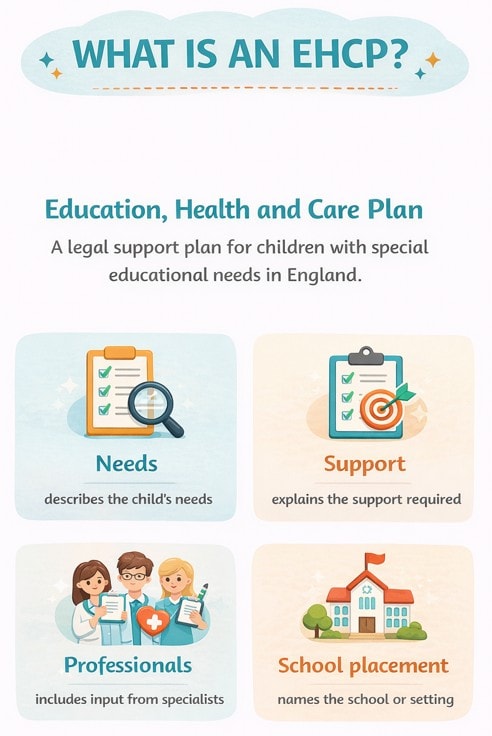
EHCP Explained: Quick Overview
An Education, Health and Care Plan (EHCP) is a legal document in England that describes the support a child or young person with special educational needs must receive.
Key facts about EHCPs:
• Applies to children and young people aged 0–25
• Issued by the local authority
• Describes a child’s needs and required support
• Includes the school or setting the child will attend
• Must normally be completed within 20 weeks
Parents can request an EHC needs assessment themselves, without needing the school’s permission.
You can read the official guidance here.
What an EHCP Is and Who It Is For
An Education, Health and Care Plan (EHCP) is a legal document issued by a local authority in England.
It describes:
- a child’s special educational needs
- the support they must receive
- the school or educational setting they will attend
EHCPs replaced the older Statement of Special Educational Needs in 2014 when the SEND system was reformed.
The plan can support children and young people from birth up to age 25 if they remain in education or training.
An EHCP is designed for children whose needs cannot be met through ordinary school support alone.
For example, a child may need:
- specialist teaching
- speech and language therapy
- occupational therapy
- one-to-one support
- assistive technology
- a specialist school placement
The key point is this:
- An EHCP is legally enforceable.
- Schools and local authorities must deliver the support written inside it.
You can read the official government overview here
EHCP vs SEN Support: What Is the Difference?
Before a child receives an EHCP, most children first receive SEN Support at school.
Understanding the difference helps parents know when to push for further assessment.
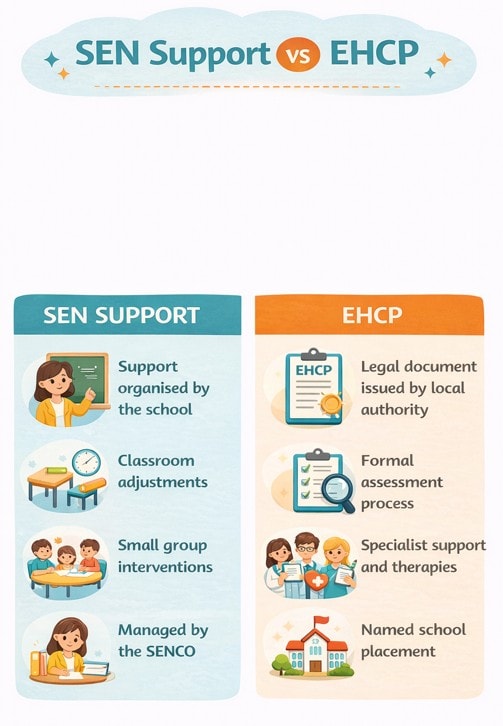
SEN Support
SEN Support is help provided directly by the school.
Examples include:
- extra teaching support
- small group interventions
- behaviour support strategies
- learning adjustments in the classroom
This support is organised internally by the school and usually coordinated by the SENCO (Special Educational Needs Coordinator).
However, the school must fund most of this support from its own resources.
EHCP
An EHCP is different in several important ways.
It is:
- issued by the local authority
- a legal document
- based on a formal EHC needs assessment
The plan sets out specific support that must be provided.
This can include therapies, specialist placements, and funded support that schools cannot provide alone.
You can read more about the legal framework in the SEND Code of Practice:
When Do Children Move From SEN Support to EHCP?
Schools should consider requesting an EHCP when:
- a child is not making progress despite SEN support
- the level of need is complex or long-term
- specialist professionals are required
Sometimes schools suggest waiting. Parents should know that waiting is not always necessary.
Parents can request an assessment themselves.
Who Can Request an EHC Needs Assessment
Many parents do not realise this.
You do not need permission from the school to request an assessment.
Under the law, the following people can request an EHC needs assessment:
- parents
- schools
- young people aged 16 or over
Parents can contact their local authority SEND team directly. The request can be made by letter or email.
The government explains this clearly here.
When making a request, it helps to include:
- your child’s details
- their school
- the difficulties they are experiencing
- evidence or reports if available
Once the request is submitted, the local authority must decide whether to assess.
How to Apply for an EHCP
The EHCP process follows several stages. Understanding the stages helps parents track whether the process is moving correctly.
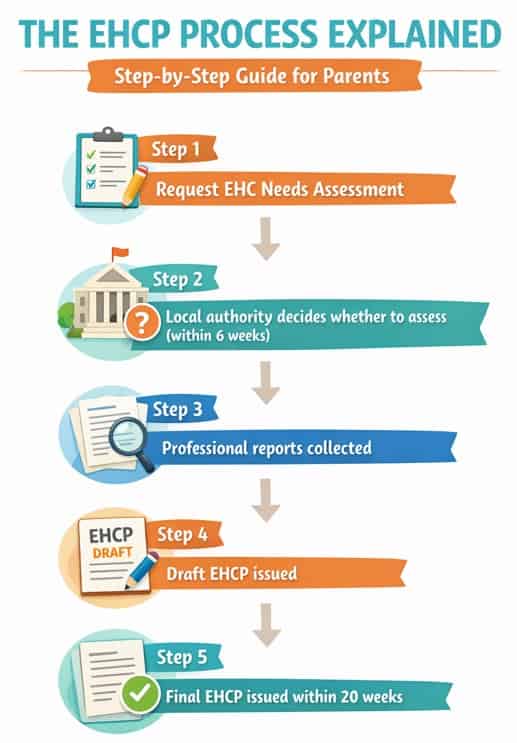
Step 1 — Request an EHC Needs Assessment
A request is sent to the local authority.
This can come from:
- the school
- the parent
- a young person aged 16+
Step 2 — Submit Supporting Evidence
The local authority will look at evidence such as:
- school records
- assessments
- professional reports
- parent observations
Evidence helps demonstrate that the child’s needs are significant enough to require formal support.
Step 3 — Local Authority Decision
Within six weeks, the local authority must decide whether to carry out an assessment.
They may:
- agree to assess
or - refuse the request
If they refuse, parents have the right to challenge that decision.
Step 4 — Assessment Reports
If the assessment proceeds, professionals may be asked to provide reports.
These might include:
- educational psychologists
- speech and language therapists
- health professionals
- social care teams
The school will also provide input.
Step 5 — Draft EHCP Issued
If the authority decides an EHCP is needed, they produce a draft plan. Parents can review this and request changes.
Step 6 — Final EHCP Issued
After feedback is considered, the final EHCP is issued. This document becomes legally binding.
What Evidence Helps an EHCP Application
Evidence is often the difference between a successful application and a refusal.
Helpful evidence can include:
- school progress reports
- Individual Education Plans (IEPs)
- SEN support plans
- behaviour records
- speech and language reports
- occupational therapy reports
- paediatric assessments
- educational psychologist reports
Parents can also provide their own observations. This is often called parental views.
Parental evidence may include:
- how the child copes at home
- communication difficulties
- sensory sensitivities
- social challenges
- emotional wellbeing concerns
These observations help professionals understand the whole picture of the child’s needs.
How to Write Strong Parental Views for an EHCP
One part of the EHCP process that many parents underestimate is the parental views statement.
Parental views allow you to describe your child’s needs in your own words.
Professional reports are important, but they usually focus on assessments carried out in structured environments.
Parents often see things professionals do not.
For example, you might notice:
- how your child copes with homework
- how long tasks take compared to peers
- how communication difficulties affect daily life
- how sensory sensitivities affect routines
These everyday experiences help professionals understand the full picture.
A helpful parental views statement usually includes:
• your child’s strengths
• the challenges they face in learning
• communication difficulties
• emotional or sensory needs
• how these difficulties affect school participation
Many parents also explain how their child copes outside school, such as at home or during social activities.
This helps professionals understand how needs affect the child beyond the classroom.
It can also help to include examples.
For instance:
Instead of writing : My child struggles with reading.
You might explain:
My child finds it difficult to decode unfamiliar words and often avoids reading tasks. Homework that involves reading usually takes significantly longer than expected.
Examples like this make the difficulties clearer.
If you want a structured way to write parental views, you may find this guide helpful:
How to Write Powerful Parental Views for an EHCP
If you would prefer guided help instead of starting from a blank page, you can use the EHCP Parental Views Generator free tool.
This tool guides you step by step and helps you create a structured draft you can review and edit before submitting.
EHCP Timeline Explained (The 20-Week Process)
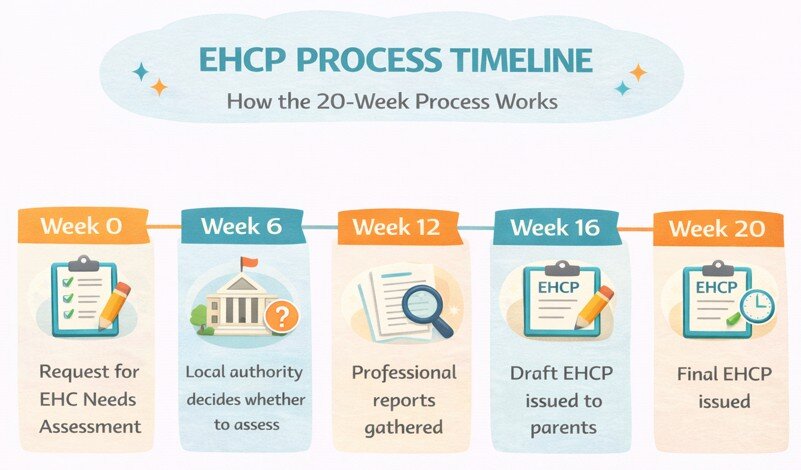
The law states that the EHCP process should take no longer than 20 weeks from request to final plan.
The official guidance can be found here:
The typical timeline looks like this.
Week 0
Assessment request submitted.
Week 6
Local authority decides whether to assess.
Week 12
Professional reports gathered.
Week 16
Draft EHCP issued to parents.
Week 20
Final EHCP issued.
In practice, delays sometimes occur. Parents should still keep track of the timeline and follow up if deadlines pass.
EHCP Timeline at a Glance
| Stage | What Happens | Typical Deadline |
|---|---|---|
| Assessment request | Parent, school, or young person requests EHC assessment | Week 0 |
| Decision to assess | Local authority decides whether to assess | Week 6 |
| Professional reports | Reports gathered from professionals | Week 12 |
| Draft EHCP issued | Parents receive draft plan | Week 16 |
| Final EHCP issued | Local authority confirms final plan | Week 20 |
More information about the timeline can be found here:
What Happens During the EHC Needs Assessment
If the local authority agrees to assess your child, several professionals may become involved.
Common contributors include:
- educational psychologists
- speech and language therapists
- paediatricians
- occupational therapists
- the school SENCO
- social care professionals in some cases
Each professional looks at different aspects of the child’s development and needs. Parents also play an important role.
You may be asked to provide parental views, which describe:
- your child’s strengths
- the difficulties they face
- what support you believe would help
These views help ensure the assessment reflects real day-to-day experiences, not just school reports.
Draft EHCP: What Parents Should Check Carefully
When the draft EHCP arrives, many parents feel relief. But this stage is extremely important.
A draft plan is not final, which means this is the moment to check everything carefully.
You normally have 15 days to review the draft and suggest changes.
The government explains this stage here.
When reading the draft EHCP, look closely at three things:
1. Are your child’s needs fully described?
The plan should clearly explain the child’s difficulties.
These may include:
- learning difficulties
- communication challenges
- sensory issues
- behavioural needs
- social interaction difficulties
If the needs are not written clearly, the support later in the document may also be weak.
2. Is the support specific?
This is one of the biggest mistakes in many EHCPs.
Support must be specific and quantified.
For example:
Weak wording: Support will be provided as needed.
Strong wording: The child will receive three 30-minute speech therapy sessions per week delivered by a qualified speech and language therapist.
Specific wording matters because Section F is legally enforceable. If the support is vague, it becomes difficult to enforce.
3. Is the school placement correct?
The draft plan may include a proposed school placement.
Parents have the right to request a different school if they believe it is more suitable.
Many parents find it helpful to get independent advice at this stage.
One of the most respected sources of guidance is IPSEA, which provides free information about SEND law.
Common Mistakes Parents Miss in Draft EHCPs
When parents first receive a draft EHCP, it often feels like a major milestone.
However, many draft plans contain issues that are not immediately obvious. Some of the most common problems include:
- Missing needs
Sometimes professional reports mention difficulties that are not fully reflected in Section B of the EHCP. If a need is missing in Section B, the plan may not include support for it later.
- Vague provision wording
Support written in unclear language can cause problems later.
For example: Support will be available when needed. This type of wording does not clearly explain what support must actually be delivered.
Specific provision is much stronger.
For example: The child will receive three 30-minute literacy intervention sessions each week delivered by trained staff.
- Missing therapy provision
If therapy recommendations appear in professional reports, they should normally be reflected in Section F of the plan.
Parents sometimes discover that therapy recommendations appear in reports but are not included in the EHCP itself.
- School placement issues
The proposed school placement should match the level of support described in the plan. If a child requires specialist provision, the placement should reflect that.
Because draft EHCPs can be complex, some parents find it helpful to review them with a structured checklist.
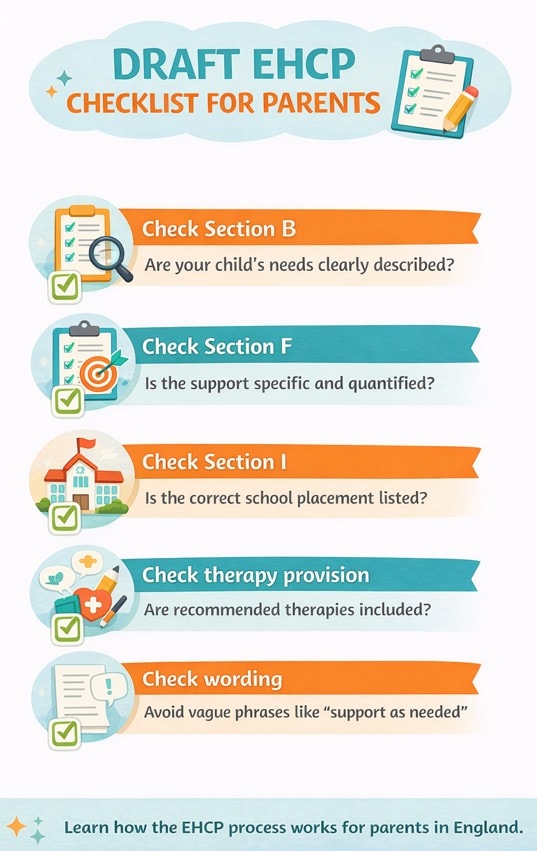
Quick Draft EHCP Checklist
When reviewing a draft EHCP, check these key areas carefully:
- Are all of your child’s needs listed clearly in Section B?
- Is the support in Section F specific and measurable?
- Are therapy recommendations included in the plan?
- Is the school placement in Section I correct?
- Is any wording vague, such as “support as needed”?
If you want a more detailed step-by-step review guide, you can read the full checklist here:
Draft EHCP Checklist for Parents
Understanding EHCP Sections (Especially B, F and I)
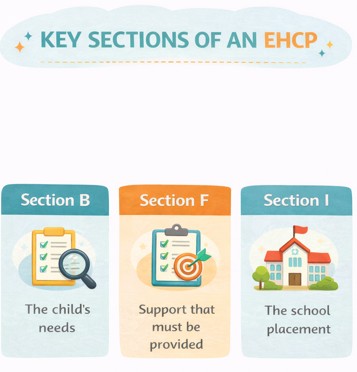
An EHCP contains several sections, each covering different information. However, three sections are particularly important.
These are Sections B, F and I.
Understanding them helps parents read the document properly.
Section B – The Child’s Needs
Section B describes the child’s special educational needs.
These might include:
- learning difficulties
- communication needs
- sensory processing issues
- social interaction difficulties
- emotional regulation challenges
Everything written in Section B should match the professional reports collected during assessment.
If a need is missing here, it may not be supported later.
Section F – Provision Required
Section F explains what support must be provided. This section must include clear and detailed provision.
Examples may include:
- specialist teaching
- therapy sessions
- structured learning programmes
- one-to-one support
- assistive technology
Section F is legally enforceable. Schools and local authorities must deliver what is written here.
Section I – School Placement
Section I names the school or educational setting.
This could be:
- a mainstream school
- a specialist school
- a specialist unit within a mainstream school
Parents have the right to request a school. The local authority must consider that request.
School Placement and Choosing a School
Many parents worry that they have no say in school placement. In reality, parents can request a school.
This can include:
- the child’s current school
- a different mainstream school
- a special school
The local authority must agree unless one of the following applies:
- the school is unsuitable for the child’s needs
- the placement would affect other pupils’ education
- the placement would involve unreasonable public spending
You can read more about school placement rules here.
Placement discussions sometimes become difficult. This is why the wording in the EHCP matters so much.
The support described in the plan should match the type of school required.
EHCP Annual Reviews Explained
An EHCP must be reviewed at least once every year. This is called the annual review.
The purpose of the review is to check whether the plan still meets the child’s needs.
The review meeting usually includes:
- parents
- school staff
- SENCO
- relevant professionals
During the review, the group may discuss:
- progress made
- whether support is working
- changes needed
- future school transitions
After the meeting, the local authority decides whether to:
- keep the plan the same
- amend the plan
- cease the plan
Parents should prepare for reviews by:
- reading the EHCP beforehand
- noting concerns
- gathering updated reports if available
Annual reviews are an opportunity to strengthen the plan if needs have changed.
Phase Transfers (Moving Schools With an EHCP)
A phase transfer happens when a child moves to a new stage of education.
Examples include:
- nursery to primary school
- primary school to secondary school
- secondary school to post-16 education
These transitions are important because the EHCP may need updating. Key deadlines apply.
For example:
When moving from primary to secondary school, the EHCP should name the new school by 15 February of the transfer year.
More information about phase transfers can be found here. Planning early helps avoid last-minute decisions.
What Happens if the Local Authority Refuses an EHCP
Sometimes the local authority may refuse to:
- carry out an assessment
or - issue an EHCP after assessment
This can be frustrating for families. However, parents have the right to challenge the decision.
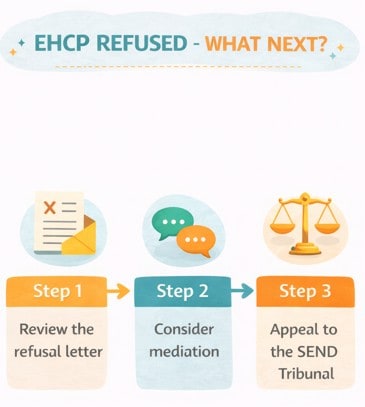
The first step before EHCP appeal is usually mediation. Information about mediation is available here.
If the issue is not resolved, parents may appeal to the SEND Tribunal. Many tribunal cases are decided in favour of families.
Understanding your rights makes it easier to navigate the process calmly.
Mediation and SEND Tribunal Explained
Mediation is an attempt to resolve disagreements between parents and the local authority.
It involves an independent mediator who helps both sides discuss the issue. Mediation is often quicker than a tribunal.
However, parents are not required to agree to mediation if they wish to proceed directly to appeal.
The SEND Tribunal is part of the First-tier Tribunal system.
It considers disputes about:
- refusal to assess
- refusal to issue an EHCP
- the contents of the EHCP
- school placement decisions
More information is available here. Tribunals examine evidence carefully and make legally binding decisions.
Can an EHCP Be Changed or Ceased?
EHCPs are not fixed forever. They can change as a child grows.
During reviews, the local authority may decide to:
- amend the plan
- update the provision
- change the educational placement
In some cases, the authority may propose to cease maintaining the plan. This may happen if they believe the support is no longer needed.
Parents have the right to challenge that decision.
EHCPs can continue until age 25 if the young person remains in education or training.
Personal Budgets and Direct Payments
Some families choose to request a personal budget.
This means part of the EHCP funding can be managed directly by the family.
It can sometimes be used for:
- therapy support
- specialist equipment
- additional services
Personal budgets are optional and not all families request them. More information can be found here.
Signs a Child May Need an EHCP
Many parents spend months wondering whether an EHCP might be appropriate for their child.
While every situation is different, certain patterns often indicate that additional support may be needed.
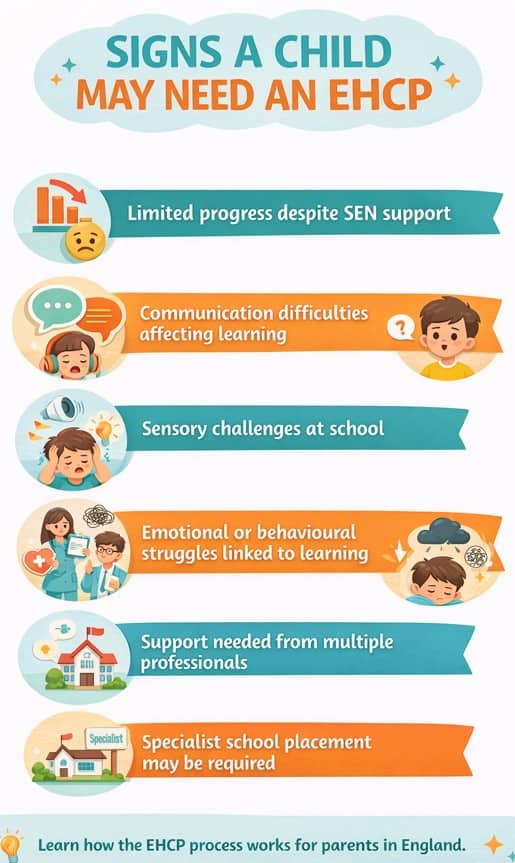
Some possible signs include:
- Limited progress despite SEN support
If a child continues to struggle despite targeted interventions and classroom adjustments, schools may begin discussing additional assessment.
- Complex learning needs
Some children require support from multiple professionals such as speech therapists, occupational therapists or educational psychologists.
In these cases an EHCP may help coordinate that support.
- Communication difficulties affecting learning
Speech and language challenges can significantly affect classroom participation, reading development and social interaction.
- Behaviour linked to unmet needs
Sometimes behaviour difficulties are linked to underlying learning, communication or sensory needs.
If the root causes are not addressed, school support alone may not be sufficient.
- Specialist provision required
If a child may require a specialist school or specialist unit, an EHCP is usually required to secure that placement.
Parents often discuss these concerns with the school SENCO before requesting an EHC needs assessment.
However, parents do not need to wait for the school to begin the process.
If you believe your child may need additional support, you can request an EHC needs assessment directly from the local authority.
Frequently Asked Questions About EHCPs
Below are some of the questions parents ask most often when navigating the EHCP process.
What does EHCP stand for?
EHCP stands for Education, Health and Care Plan.
It is a legal document that describes a child’s special educational needs and the support they must receive.
How long does an EHCP take?
The process should take no longer than 20 weeks from request to final plan.
However, delays can sometimes occur.
Can a school refuse to apply for an EHCP?
Yes. Schools may decide not to request an assessment.
However, parents can request an EHC needs assessment themselves directly from the local authority.
Can parents request an EHCP themselves?
Yes.
Parents can apply directly to the local authority without needing permission from the school.
Can you choose your child’s school with an EHCP?
Parents can request a school.
The local authority must consider the request unless there are legal reasons to refuse the placement.
What happens if the local authority refuses an EHCP?
Parents can challenge the decision.
This usually begins with mediation and can proceed to the SEND Tribunal if necessary.
Can an EHCP be taken away?
Yes.
During annual reviews, the local authority may decide the plan is no longer required. Parents have the right to appeal that decision.
Does an EHCP continue after age 16?
Yes.
EHCPs can continue until age 25 if the young person remains in education or training.
This guide gives you a clearer understanding of how the EHCP process works in England and what to expect at each stage.
When the system is unfamiliar, it can feel complicated.
Breaking the process into stages makes it easier to navigate and ensures you know what to expect at each step.
SEND Parent Resources for Each Stage
Some parents want more structured support they can work through step by step.
If you want clear guidance, writing support, and help preparing for different stages of the EHCP process, you can explore the SEND Parent Resource here.
This includes:
• SEND Parent Advocacy Guide
• EHCP Parental Views Writing Kit
• Draft EHCP Review Toolkit
• SEND Parent Meeting Planner
• EHCP Refusal & SEND Tribunal Survival Guide
Tools That Can Help You Navigate the EHCP Process
Understanding the EHCP system is one part of the journey.
Many parents also find it helpful to have practical tools that help organise thoughts, prepare for meetings, and keep track of communication with schools.
You can explore the SEND Parent Toolkit here.
Inside the toolkit, you will find tools to help you:
• prepare for EHCP meetings
• organise reports and evidence
• write parental views
• request EHCP assessments
• keep clear records after school conversations
You can use one tool or several depending on where you are in your journey.
You may also find additional guidance in the Parent Advocacy section, where SEND processes are explained step by step.
A Gentle Reminder for Parents
Navigating SEND systems can take a lot of emotional energy. Forms, meetings, reports, emails, timelines.
Many parents find themselves constantly thinking about the next step for their child.
It is easy to forget that your own wellbeing matters too.
If you ever feel overwhelmed, you may find these simple reflection tools helpful.
They are designed to help you pause and notice where life may be asking more of you than usual.
You can explore the Self-Care Check-Ins here.
Sometimes a few quiet minutes of reflection can make the next conversation with school feel a little calmer.
Trusted SEND Information Sources
If you want to explore official information about EHCPs and SEND law, these organisations provide reliable guidance.
UK Government SEND guidance
https://www.gov.uk/children-with-special-educational-needs
SEND Code of Practice
https://www.gov.uk/government/publications/send-code-of-practice-0-to-25
IPSEA – Independent Provider of Special Education Advice
https://www.ipsea.org.uk
Contact – charity supporting families with disabled children
https://contact.org.uk
These organisations provide detailed information about SEND rights, EHCP processes and school support.
This article is part of the Pheel Pretty SEND Parent Guidance series, where complex parts of the SEND system are explained step by step.
Find Your Way Back to Yourself, One Step at a Time
Life does not always feel light.
Sometimes it’s money stress.
Sometimes it’s confidence.
Sometimes it’s just trying to hold everything together.
This space is for finding calm, clarity and a way forward without pressure.
I share simple, practical ways to feel more in control of your life, your money and yourself.