How to write parental views EHCP
When a child goes through an Education, Health and Care (EHC) needs assessment, parents are usually asked to submit something called EHCP parental views.
This is one of the most important parts of the process.
Schools submit reports.
Professionals write assessments.
But parental views describe something different.
They explain what life is actually like for your child. Not just what is seen in school. Not just what is written in reports. But what happens across the whole day.
This includes things professionals may not see during short observations or school visits.
What happens after school.
What happens when your child is tired.
What happens when they feel overwhelmed.
Many parents feel unsure when they reach this stage. Questions often come up such as:
• What exactly should I write?
• Does it need to sound formal?
• How long should it be?
The truth is that parental views do not need complicated language. They do not need to sound professional.
They simply need to describe your child clearly and honestly. That is what makes them powerful.
If you are still learning about the EHCP process, you may find this guide helpful first: EHCP Explained for Parents
What Are Parental Views?
Parental views are a written statement that explains:
• your child’s strengths
• the difficulties they experience
• how those difficulties affect daily life
• what support you believe would help them
The local authority must consider parental views during the EHC needs assessment. This is not optional.
It is part of the evidence.
The importance of parental input is explained in the official SEND Code of Practice:
Your perspective matters because you see your child in many different environments:
• at home
• during homework
• during social situations
• when they are tired or overwhelmed
You see the build-up. You see the after-effects. You see the parts that are not always visible in school.
This broader view helps decision-makers understand the child more fully.

Why Parental Views Matter
Professional reports often focus on specific areas.
For example:
A school may describe academic progress.
A therapist may describe communication skills.
These are important. But they are only part of the picture.
Parents, however, often see patterns across the whole day. You see how everything connects.
For example:
A child may appear calm at school. They follow instructions. They do not draw attention.
But when they get home, everything changes.
They may become extremely distressed.
They may shut down.
They may refuse to do anything else.
This can happen because they have been holding everything in all day.
Trying to cope. Trying to fit in. Trying to manage. This is often missed if parental views are not clear.
Details like this help professionals understand the true impact of a child’s needs.
Clear parental views can also help ensure that the EHCP reflects the child’s real experiences.
Not just what is visible. But what it actually costs the child to get through the day.
Clear parental views can also help ensure that the EHCP reflects the child’s real experiences.
Without this, support can be based on an incomplete picture.
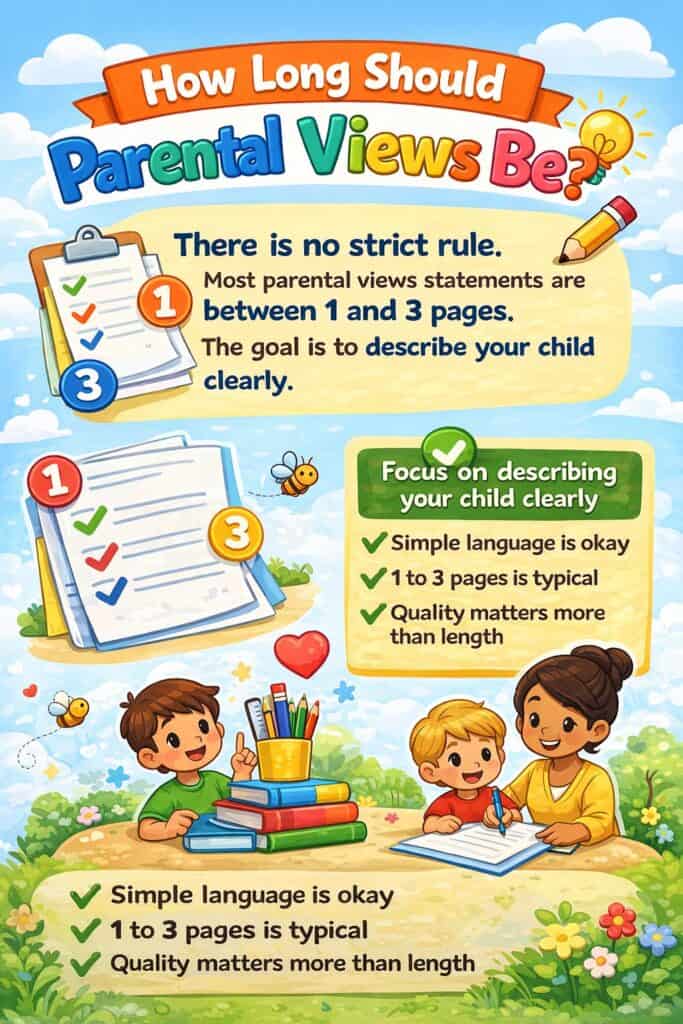
How Long Should Parental Views Be?
There is no strict rule.
Most parental views statements are between 1 and 3 pages. Some are shorter. Some are longer.
The goal is not to write a long document. The goal is to describe your child clearly.
Simple language is perfectly acceptable. In fact, it is often better.
If someone can read what you have written and understand your child more clearly, then it is enough.
A Clear Structure for Writing Parental Views
Many parents find it easier to write parental views using a simple structure.
You do not need to write everything at once. You can build it step by step.
The following sections work well.
1. Start With Your Child’s Strengths
Begin by introducing your child.
Include:
• their age
• their interests
• things they enjoy
• things they do well
Starting with strengths helps create a balanced picture.
It reminds everyone that your child is more than their difficulties.
Example:
My child is curious and creative. He enjoys building with Lego, drawing animals, and learning about nature. He has a strong memory for things that interest him and can focus deeply on topics he enjoys.
This section helps professionals see the whole child, not just the difficulties.
It also sets the tone for the rest of the document.
2. Describe Communication and Interaction
Next, explain how your child communicates. Think about both understanding and expressing.
You might describe:
• speech delays
• difficulty understanding instructions
• challenges joining conversations
• difficulty making friends
• literal interpretation of language
Try to include real examples.
Example:
When instructions contain several steps, my child often becomes confused and needs them repeated one at a time.
Another example:
My child finds it difficult to join conversations with other children and often prefers to play alone.
Examples make your description easier to understand. They show what this actually looks like in real life.
3. Describe Learning and Attention
This section explains how your child experiences learning.
Not just what they achieve. But how they get there.
You might include:
• difficulty concentrating
• slow processing speed
• struggling with reading or writing
• needing repeated explanations
• finding transitions between activities difficult
Again, simple examples help.
Example:
Homework tasks that should take 15 minutes often take over an hour because my child needs frequent reassurance and repeated explanations.
This shows the effort involved. Not just the outcome.
4. Describe Sensory or Physical Needs
Many children with additional needs experience sensory differences.
These can have a big impact on how they cope in school.
Examples include:
• sensitivity to noise
• difficulty with crowded environments
• discomfort with certain textures
• difficulty sitting still for long periods
These experiences can affect how a child manages school environments.
These experiences can affect focus, behaviour and emotional wellbeing.
Example:
Busy classrooms can become overwhelming for my child. When noise levels rise, he often becomes distressed and struggles to focus on the task in front of him.
This helps explain why certain environments are difficult.
5. Describe Social and Emotional Wellbeing
School is not only about learning. It is also a social environment.
This section may include:
• anxiety
• difficulty understanding social cues
• frustration with learning tasks
• emotional regulation challenges
Explain what happens when your child feels overwhelmed.
Example:
When my child feels overwhelmed, he may withdraw from activities or become very frustrated. This often happens when instructions are unclear or when the environment becomes too busy.
You can also describe how long it takes your child to recover. This is often important.
6. Describe the Support Your Child Needs
Finally, explain what support you believe would help.
You do not need to write legal language. You do not need to use professional terms.
Simply describe what would make school easier for your child.
Examples might include:
• smaller group teaching
• speech and language therapy
• structured routines
• additional adult support
• quiet learning spaces
Example:
My child benefits from predictable routines and clear instructions. Support from a teaching assistant during transitions between activities would help him manage the school day more confidently.
This section connects everything you have described. It shows what support would make a difference.

If You Want More Help Putting This Together
Writing parental views can feel clear when you are reading a guide.
But when you sit down to actually write it, it can still feel difficult.
If you want something more structured to guide you step by step, you can use this SEND Parent Resource.
It brings everything together in one place.
• clear guidance
• practical tools
• structured prompts
• examples you can follow
So you are not trying to figure everything out on your own.
Practical Tips When Writing Parental Views
Keep language simple. Use real examples. Focus on describing your child rather than trying to sound formal.
You do not need to impress anyone. You just need to be clear.
Some parents find it helpful to write notes over several days before completing the document.
You might notice things at different times. That is normal.
You might also want to read independent guidance from organisations such as: IPSEA
A Simple Example Opening
Many parents find it helpful to see a short example.
Example opening paragraph:
My child is kind, thoughtful and very curious about the world. He enjoys drawing, building things and learning about animals. However, he finds many parts of the school day difficult, particularly when instructions are unclear or when the classroom environment becomes noisy and busy. These challenges affect his ability to focus, participate in group activities and feel confident in school.
This kind of opening gives professionals a clear picture.
This kind of opening gives professionals a clear picture.
It is simple.
It is balanced.
It is easy to understand.
Where Parental Views Fit in the EHCP Process
Parental views are usually submitted during the EHC needs assessment stage.
They form part of the evidence used to decide whether an EHCP should be issued.
They sit alongside:
• school reports
• professional assessments
• other supporting evidence
If you would like to understand the full EHCP process step by step, you can read the full guide here: EHCP Explained for Parents
What Makes Parental Views Strong
Strong parental views are not just using the right words. They are about being clear.
They help someone understand your child without having to guess.
When someone reads your parental views, they should be able to picture your child’s day.
What is easy for them.
What is difficult.
Where things start to break down.
Strong parental views usually have a few things in common.
They are specific. They include real examples. They describe patterns, not just one-off situations.
For example, instead of saying: My child struggles with transitions.
You could say:
My child finds it very difficult to move from one activity to another. At the end of lessons, he often becomes anxious and needs extra time and support to move on to the next task.
This makes it clearer. It shows what actually happens.
Strong parental views also explain impact. Not just what the difficulty is. But what it leads to.
For example:
Because of this, my child often becomes overwhelmed and may refuse to continue with the activity or disengage completely.
This helps professionals understand why support is needed. Not just that something is difficult.
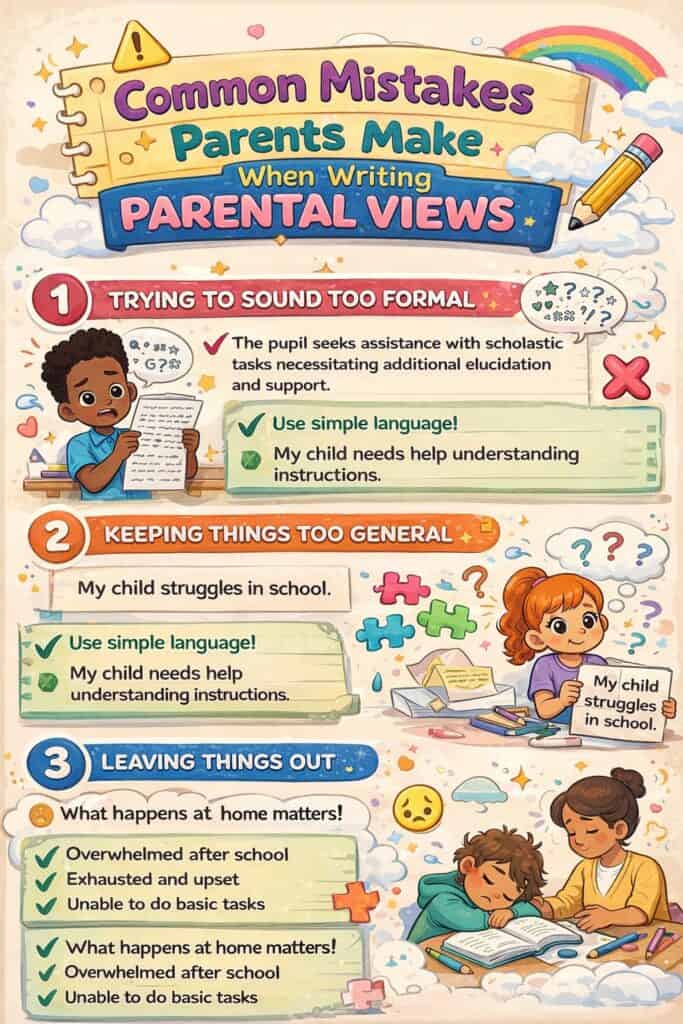
Common Mistakes Parents Make When Writing Parental Views
Many parents feel pressure to get this right. That pressure can make things harder than they need to be.
There are a few common mistakes that come up. Trying to sound too formal is one of them.
Parents sometimes feel they need to write like a professional report.
Long sentences. Complicated wording. This is not needed. It can actually make things less clear.
Simple language is always better.
Another mistake is keeping things too general. For example: My child struggles in school.
This does not explain what is actually happening. It leaves too much open to interpretation.
It is much clearer to say:
My child struggles to follow instructions when they are given in more than one step and often needs support to stay focused during tasks.
This gives a clear picture.
Another mistake is focusing only on one side. Only strengths or only difficulties. Both matter.
A balanced picture helps people understand your child properly.
Some parents also leave out what happens at home. This is important.
What happens after school often shows the real impact of the day.
If your child comes home exhausted, overwhelmed, or unable to continue with basic tasks, that matters. That is part of the evidence.
If You Are Feeling Unsure About Getting It Right
Many parents worry about saying the wrong thing or missing something important.
You do not have to figure it out alone.
The SEND Parent Resource was created to make this process clearer and more manageable.
It walks you through:
• what to write
• how to structure it
• what to include
• how to feel more confident doing it
You can explore it here.
A Simple Way to Start If You Feel Stuck
Starting is often the hardest part. Many parents sit with a blank page and don’t know where to begin.
You do not need to write everything perfectly. You can start with simple notes.
Think about your child’s day.
Morning.
School.
After school.
Evening.
What goes well?
What is difficult?
What support do they need?
Write it down as it comes. You can shape it later. You can also use guided tools to make this easier.
If you do not want to start from scratch, you can use this free tool: EHCP Parental Views Generator
This tool guides you step by step. It prompts you with the right questions so you are not guessing what to include.
Many parents find this removes the pressure completely. You are no longer staring at a blank page.
You are simply answering questions about your child.
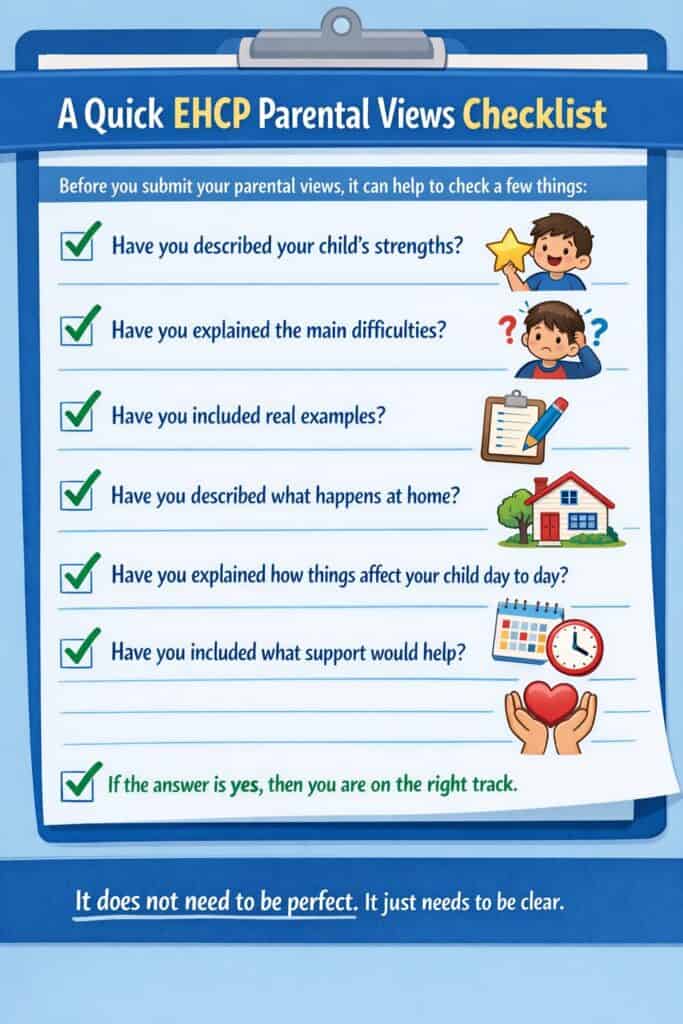
A Quick EHCP Parental Views Checklist
Before you submit your parental views, it can help to check a few things.
Have you described your child’s strengths?
Have you explained the main difficulties?
Have you included real examples?
Have you described what happens at home?
Have you explained how things affect your child day to day?
Have you included what support would help?
If the answer is yes, then you are on the right track. It does not need to be perfect. It just needs to be clear.
You Do Not Have to Do This Alone
Trying to understand the SEND system while supporting your child can feel overwhelming.
There is a lot of information. And it is not always explained clearly.
That is exactly why these tools were created. If you need more support, you can explore the full SEND Parent Toolkit.
It includes practical tools to help you:
• organise your evidence
• prepare for meetings
• understand what to expect
• write with more clarity and confidence
You can use one tool or several depending on where you are in your journey.
If you want something more structured to support you through this process, you can explore the SEND Parent Resource.
It is designed to give you calm, practical guidance without overwhelm.
A Quiet Reminder for Parents
You know your child. You see what others do not see. You do not need perfect words to explain that.
You just need to describe what is real. That is enough.
If You Want Ongoing Support With SEND
If you are going through EHCP assessments, reviews, or school meetings, having the right tools can make this much clearer.
The SEND Parent Resource brings everything together in one place so you are not trying to figure it out on your own.
You can access it here.
If you want to start with something free, you can use the Parental Views Generator.
You can also explore the full SEND Parent Toolkit here.
These resources explain SEND processes clearly and provide tools that help parents organise reports, prepare for meetings and advocate confidently for their child.
Find Your Way Back to Yourself, One Step at a Time
Life does not always feel light.
Sometimes it’s money stress.
Sometimes it’s confidence.
Sometimes it’s just trying to hold everything together.
This space is for finding calm, clarity and a way forward without pressure.
I share simple, practical ways to feel more in control of your life, your money and yourself.